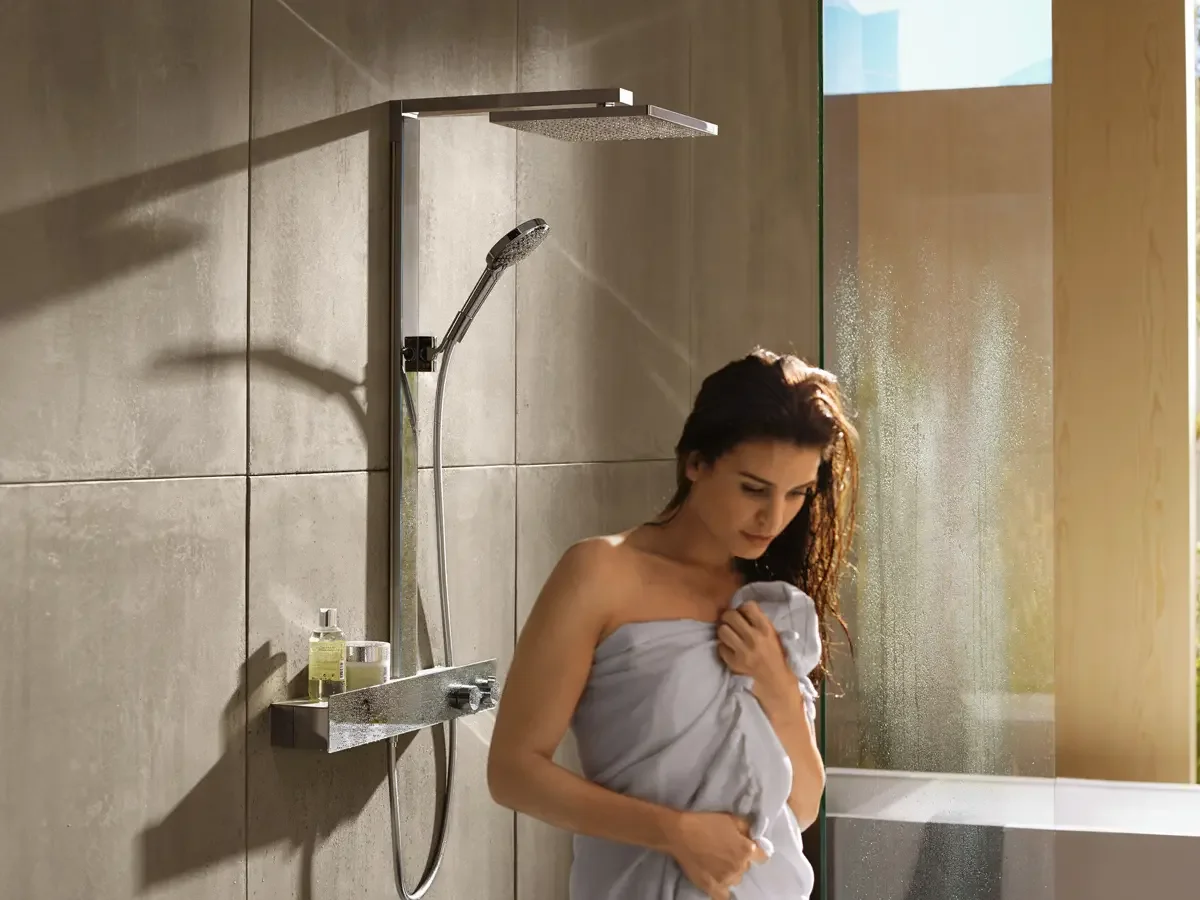
An enveloping overhead shower changes the bathroom experience, but it also places demands on hot-water production. A good selection brings together the shower's requirements, production capacity and household habits. Check these as soon as you select a model, especially when renovating.
01
Start with the shower specification
Record the flow of the exact reference, the conditions under which it is stated and any operating restrictions. Two versions within one collection may have different requirements. The head's visible size does not, on its own, tell you its consumption.
Some hansgrohe specifications indicate suitability for instantaneous water heaters. That does not mean every existing appliance will deliver the expected comfort. Compare the statement with the characteristics and condition of the actual installation.
02
Distinguish stored and instantaneous hot water
With a cylinder, comfort depends partly on usable stored water and successive uses. With instantaneous production, activation conditions and the ability to heat the required flow must be examined. Have a qualified professional check this.
An occasionally used bathroom behaves differently from two showers used consecutively every morning. Describe household routines, associated outlets and expected duration. These details are more useful than an estimate based only on the number of people.
03
Study the intended showering mode
An overhead and a hand shower do not necessarily operate together. Identify the control's possibilities and the intended scenario. With several outlets, mixer selection and hot-water production should be studied as one system.
Also request comparison with a reduced-flow version where one exists for the intended use. The aim is to retain a satisfying spray under project conditions. Flow figures should remain connected to comfort, available pressure and product documentation.
04
Check comfort at handover
Commissioning tests should cover the intended uses and perceived stability. Record adjustments and any limits explained by the installer. Unstable temperature needs diagnosis; it should not automatically be blamed on the new shower.
To prepare your discussion with EDIFIS, bring the water heater's reference or sheet, available measurements and the bathroom plan. This coordination lets you compare hansgrohe or Deante solutions technically before choosing their aesthetic expression.
Before you decide
- Record the exact shower's requirements.
- Identify the hot-water production method.
- Describe successive and simultaneous uses.
- Test stability after installation.
The essentials
Your questions, our guidance.
Does a large diameter always mean high flow?
No. Flow depends on the model and its technologies. Compare the precise product sheets.
Is a statement of compatibility with instantaneous heaters enough?
No. A professional must check that the installed appliance can work correctly at the expected flow and conditions.
From idea to project
Discover at EDIFIS
Discover hansgrohe showersExplore DeantePrepare your bathroom projectConfirm references, configurations, finishes and availability for your project.
Documentation & references
EDIFIS design advice. For specifications and installation, consult the documentation for the selected reference.
hansgrohe · Raindance E operating conditions ↗