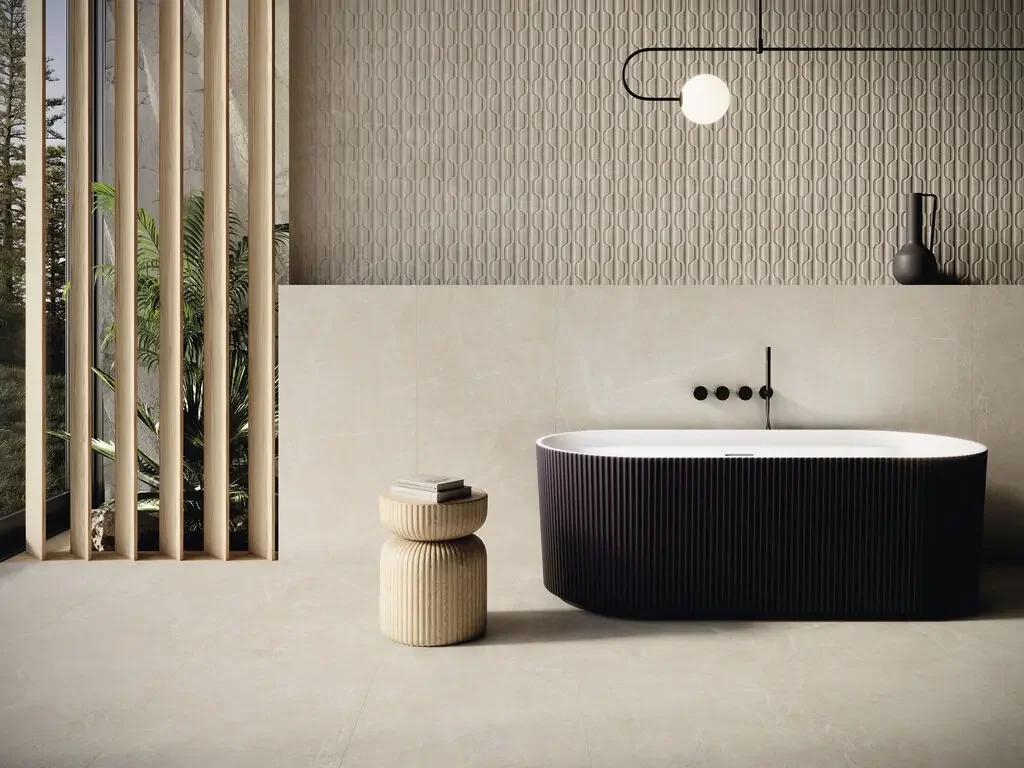
Relief tiles change a wall with the viewing angle and lighting. Regular fluting, grooves or more irregular textures bring a tactile presence to the bathroom. To make this effect work, the light’s location matters as much as the finish’s.
01
Give relief a surface that can be read
A basin wall or side wall visible from the entrance allows the texture to be appreciated. Behind a large mirror or in a dim corner, part of the effect disappears. First draw the surface that will actually remain visible once equipment is installed.
Contemporary collections offer different depths of relief. Cifre Bars, for example, is a white-body wall tile in 40 × 120 cm format. This example is a reminder that wall decoration must not automatically be treated as floor tile.
02
Test lateral light without glare
Oblique lighting reveals relief shadows. Very grazing light can also emphasise every break in plane or irregularity. Test the sample with a movable light source to understand the effect before fixing the lights’ positions.
Separate decorative lighting from the light needed on the face. A highly sculptural wall can be beautiful while giving uncomfortable lighting at the mirror. The composition should combine both functions without forcing a choice between them.
03
Prepare contact areas for equipment
A wall-tap escutcheon or flush plate needs a properly prepared interface. Relief around these elements can complicate junctions. Have installation details approved rather than assuming the parts will follow the surface.
One solution is to reserve a smooth area behind the tap or limit relief to a neighbouring wall. The design remains strong while equipment has a simpler support to finish and maintain.
04
Assess care in the selected area
Recesses and projections change cleaning access. Behind a basin or near water, examine where splashes may collect. The reference’s finish and care instructions should guide placement.
A quieter material on the floor and secondary walls can balance the texture. Simple-lined taps then allow the relief to play its role. Decoration becomes more convincing when not every surface competes for attention.
Before you decide
- Measure the relief area that will remain visible.
- Test lighting on a sample.
- Prepare escutcheon and plate interfaces.
- Check the decoration’s use and care.
The essentials
Your questions, our guidance.
Can textured wall tiles be used on the floor?
Only if the manufacturer explicitly allows that use for the reference. Relief or ceramic appearance alone does not establish suitability.
Must every wall be covered?
No. A single well-lit wall can establish a strong identity while keeping the atmosphere calm and cleaning simpler.
From idea to project
Discover at EDIFIS
Explore Cifre CerámicaPrepare wall-mounted tapsView finishes in the showroomConfirm references, configurations, finishes and availability for your project.
Documentation & references
EDIFIS design advice. For specifications and installation, consult the documentation for the selected reference.
Cifre Cerámica · Bars ↗