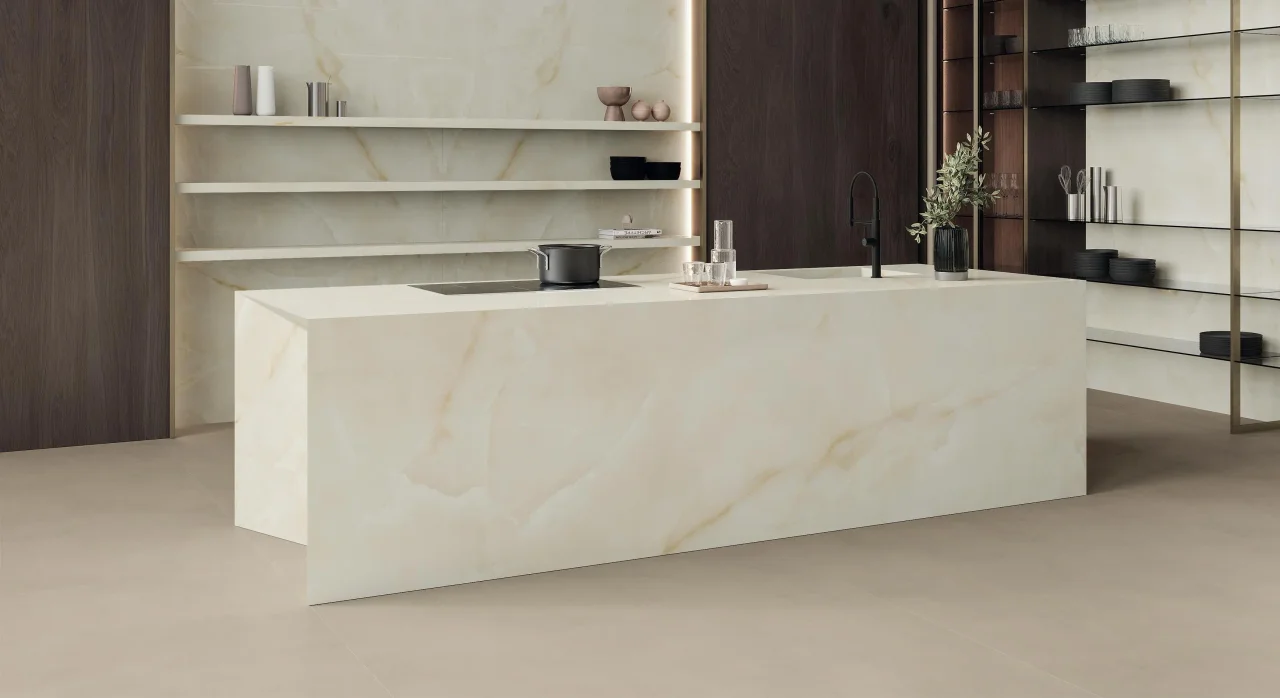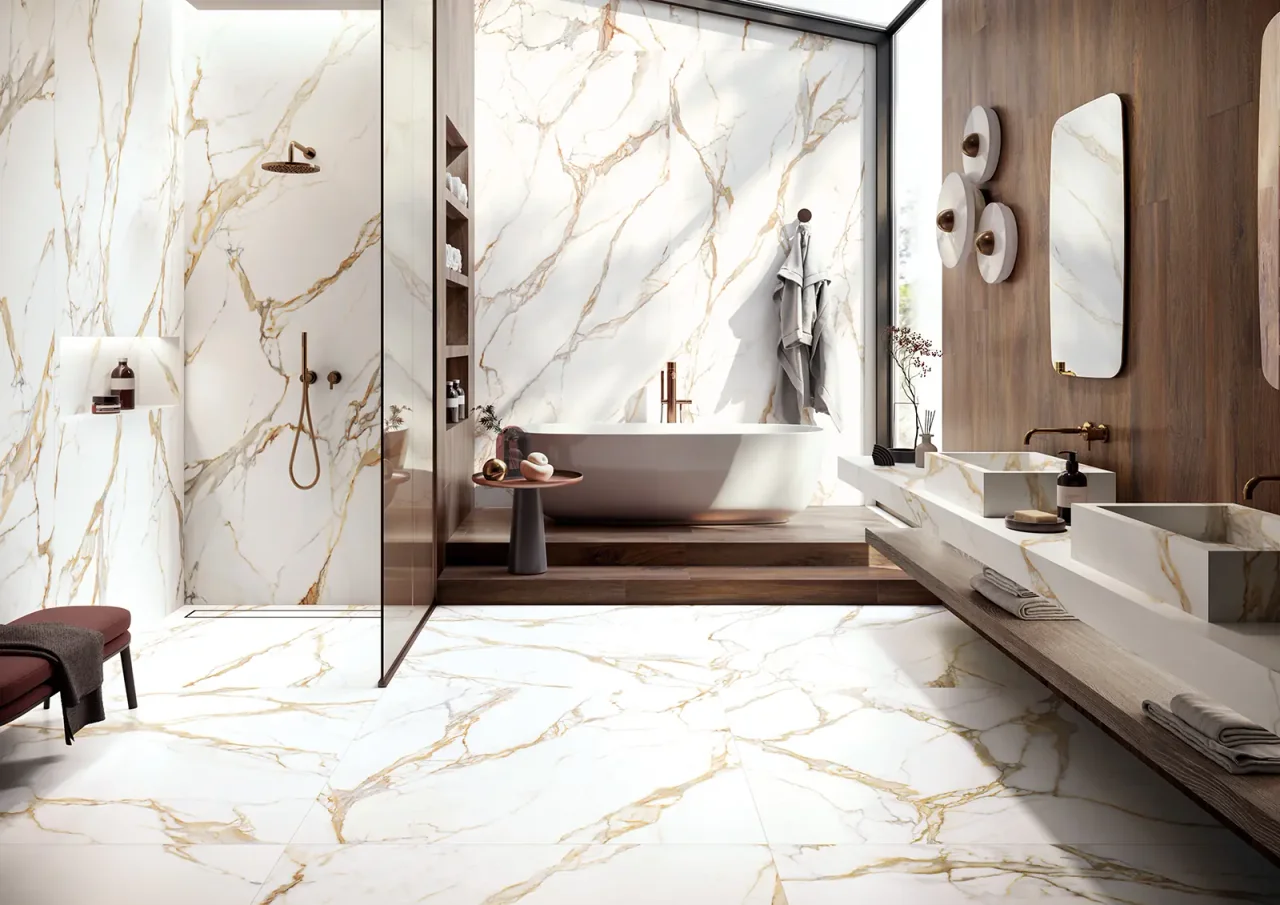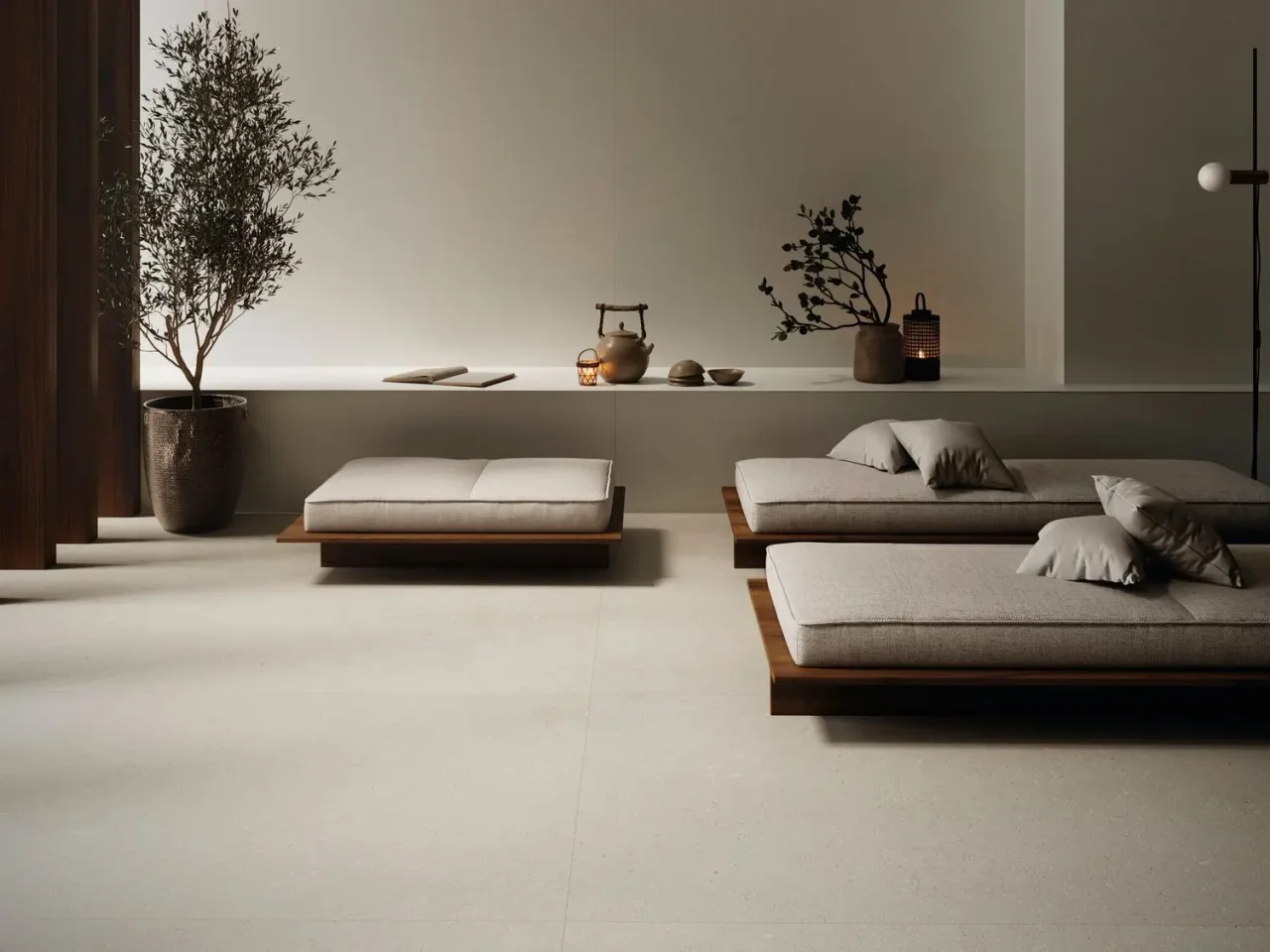
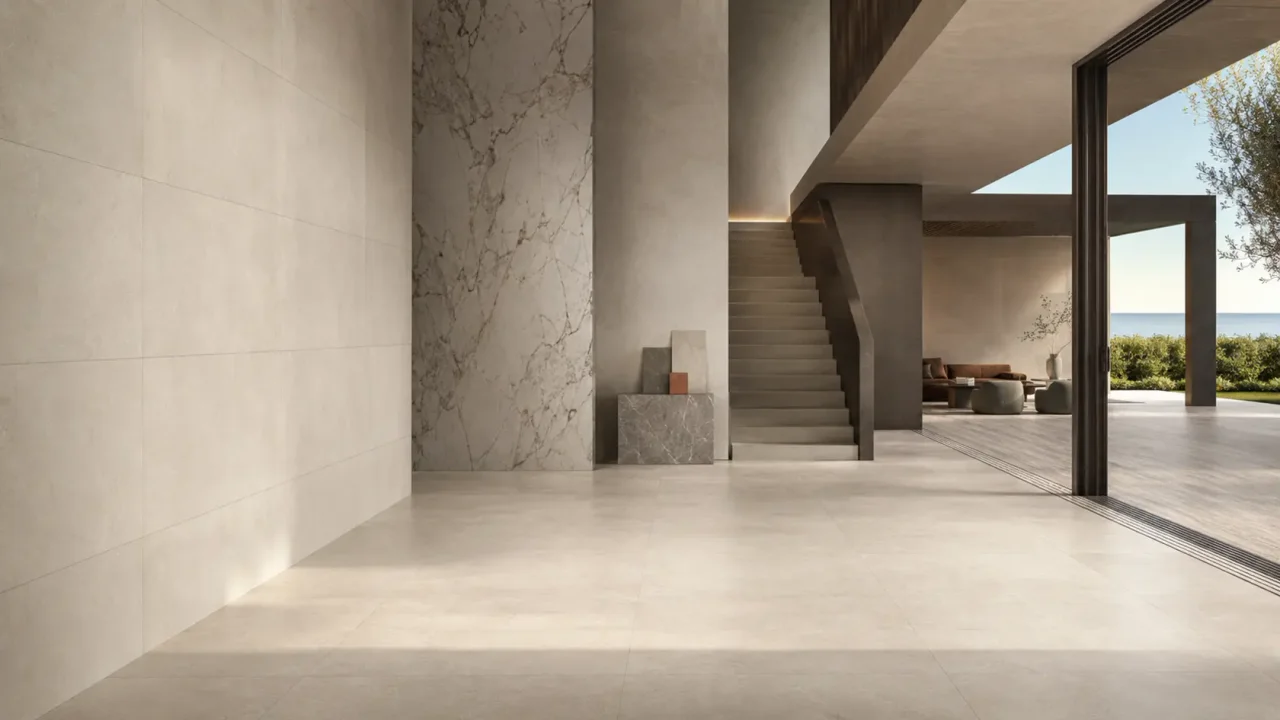
Choosing a covering often starts with falling for an image. To make it work at home, understand what its pattern does to the space. Stone, marble and concrete effects each organise contrasts, light and the presence of other objects differently.
01
Stone effect: a foundation with nuances
A restrained stone effect can unify floors and walls while allowing furniture and tapware to stand out. But different visual stones produce different results: observe tonal variation, pattern scale and repetition from tile to tile.
In a compact room, a low-contrast surface is one compositional option. In a large volume, more variation may add rhythm. Examine several tiles because one sample does not always represent the full pattern.
02
Marble effect: create a focal point
Veins attract attention and establish direction. Decide where to concentrate them: behind a basin, in a shower or across a large wall. The rest of the room can repeat a secondary colour from the pattern to create continuity.
If you want a composed vein arrangement, verify what the collection actually permits. Not all marble-effect tiles are designed for bookmatching. Prepare the layout from available faces and formats.
03
Concrete effect: a setting for details
Concrete effects can provide a background for graphic tapware, wood or a brighter colour. Tagina’s City Stone collection includes a Fumo shade, illustrating the nuances available within this mineral vocabulary.
The choice is not simply light or dark. Texture and lighting alter perception. In a poorly lit room, compare one sample vertically and another horizontally to anticipate wall and floor appearance.
04
The right effect does not replace the right specification
Atlas Concorde, Tagina and Cifre Cerámica offer different decorative approaches. At EDIFIS, compare references suited to your use, then confirm sizes, finish, quantities and availability. A collection in an international catalogue is not necessarily immediately available in Tunisia.
Floor or wall use and expected performance in wet areas must be checked on the technical sheet. Do not infer performance from a photograph. Finally, coordinate joints, edges and junctions: they contribute as much as the surface to the final result.
Before you decide
- Choose the dominant surface.
- Examine several tile faces.
- Validate the finish for each area.
- Coordinate joints, cuts and transitions.
The essentials
Your questions, our guidance.
Is marble-effect porcelain natural marble?
No. It is a ceramic covering whose pattern evokes marble. Installation and cleaning must follow its own documentation.
Can the same collection be used on floors and walls?
Yes, where the selected references and finishes suit the intended locations. Check each product.
From idea to project
Discover at EDIFIS
EDIFIS surfacesTagina in TunisiaAtlas Concorde in TunisiaConfirm references, configurations, finishes and availability for your project.
Documentation & references
EDIFIS design advice. For specifications and installation, consult the documentation for the selected reference.
Tagina · City Stone ↗Atlas Concorde · collections and effects ↗